Once Upon a Time in China
III
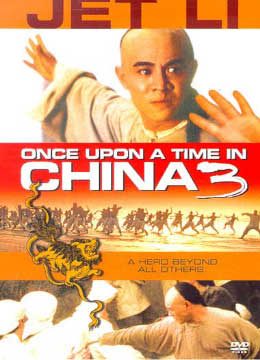
Reviewed by YTSL
Before the opening credits roll in that whose
Chinese title translates into English as “Wong Fei Hung 3: Lion King
Struggle(s) for Supremacy”, the viewers of this Film Workshop production are
made privy to a conversation between the Dowager Empress Tzu Hsi and her
Prime Minister. In it, the imperial personage seemed to knowingly assert
that “these foreigners” who abound(ed) in China’s capital city as well as
elsewhere “are tricky” but then undermined the sense that she really knew
them by asking her Prime Minister, in all seriousness, “don’t you think that
the foreigners will be scared to death by our lions?” (This especially so
when the lions in question were not wild creatures but artificial ones of
the kind that need to be “brought to life” -- in dances and (usually) on
ceremonial occasions -- by humans).
Relatedly, the Prime Minister’s suggestions that “our foreign policy should
be to play one (foreign) country against another...(in order to) create conflicts
among them” and “our internal policy should be to encourage the trend in
martial arts” may seem theoretically sound; what with the former being akin
to the “divide and conquer” idea that worked so well for the British colonialists
and the latter appearing to be a pro-physical health perspective that Wong
Fei Hung would whole-heartedly endorse. However, as succeeding events
depicted in ONCE UPON A TIME IN CHINA III show, what can also transpire from
such edicts issued from on high are communally divisive plus strength-sapping
internal conflicts that are seriously in danger of being taken advantage
of by China’s powerful “gwailo” neighbors along with glory-seeking native
individuals.
When viewed in this manner, the third installment in Tsui Hark’s ONCE UPON
A TIME IN CHINA series can be looked upon as one in which the auteur -- who
has directing, producing and co-scriptwriting (along with the eccentrically
monikered Charcoal Cheung) credits for this 1993 effort -- and the Cantonese
folk hero who is at the center of this group of works attempt to enlighten
the sadly out of touch government as well as strike blows against those groups
and individuals who more directly threaten the well-being of Wong Fei Hung’s
beloved homeland -- enlarged here by Wong Fei Hung’s father, Fu Shan native
Wong Kei Ying, being shown to now reside outside of Canton/Guandong province
(More specifically, in the capital city of Peking/Beijing) -- and its people.
Still, this (re)viewer gets the sense that what mattered much more to many
(other) Hong Kong movie fans about this offering from the often masterful
plus political film maker -- whose style has been characterized by the likes
of Stephen Teo as “nationalism on speed” -- was it being filled with lots
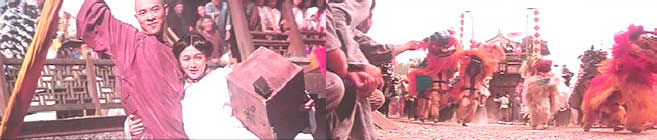
of color (courtesy of the hundreds of battling as well as performing lions
on display) and action (particularly that executed by Mainland Chinese wushu
wizards turned action actors, Jet Li and Xiong Xin Xin).
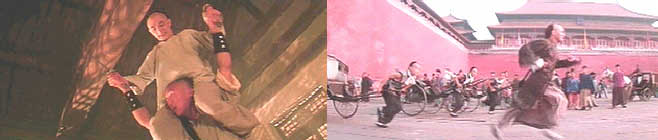
Viewed in terms of such as on screen time devoted to it, political actions
and commentary do largely take a backseat in ONCE UPON A TIME IN CHINA III
to such as the highly spectacularly choreographed (by Yuen Tak), expertly
edited (by HKFA nominees, Mak Chi Sin and Lam On-Yee) as well as fiercely
enacted fight action. Even the often too timid plus gentle attempts
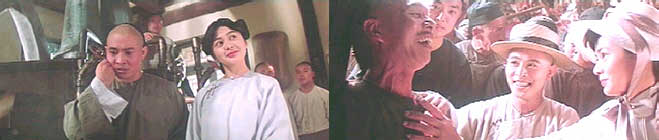
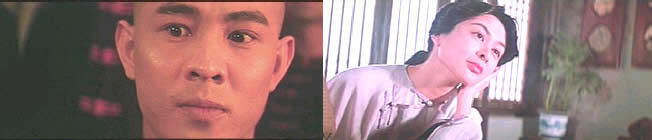
to confirm and further develop the love between Wong Fei Hung (Jet Li makes
his third masterful appearance as the rightly respected Wong Sifu) and his
honorary Saap Sam Ee (She who would prefer to not be addressed as Thirteenth
Aunt by him is sweetly played once more by Rosamund Kwan) -- that are somewhat
complicated in this movie by the shock of Wong Kei Ying (essayed by the versatile
Lau Shun) over this seemingly unlikely romantic pairing and Saap Sam Ee’s
re-encounter with a Cantonese-speaking Russian male friend named Tomansky
(portrayed by John Wakefield) as well as the buffoonery that viewers will
have come to expect of Wong Fei Hung disciple, Leung Foon (Max Mok has this
once more generally thankless role) -- can appear to overshadow those intrigues
which, nevertheless, could have grave international as well as national repercussions.
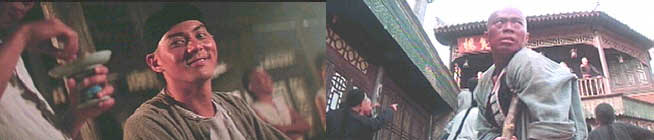
To a similar degree, the kind of stunning individual martial artistry and
awe-inspiring one-on-one battles that were visual highlights of the two previous
segments of Tsui Hark’s Wong Fei Hung saga are mainly eschewed here in favor
of lengthy and chaotic looking mass brawls involving scores of men, who are
as much -- or even more likely to consist of -- teams of lion “dancers” as
actual representatives of (rival) kung fu schools or other community organizations.
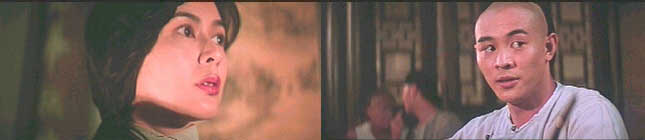
Something else to note here is that, although Wong Fei Hung does have a couple
of good opportunities to demonstrate his martial arts expertise in ONCE UPON
A TIME IN CHINA III, this (re)viewer is of the opinion that the most breathtaking
display of physical power and prowess is by an individual known as Clubfoot
(portrayed by an intense Xiong Xin Xin, who earned a HKFA Best Newcomer nomination
for “Once Upon a Time in China II” but impresses even more in this effort).
Either because many of its viewers don’t share the film’s makers major love
for lion dance or as a consequence of their having made the at times pretty
surprising choices that they did regarding what to foreground and background
in this still quite original follow-up effort, ONCE UPON A TIME IN CHINA
III does not seem to be as highly thought of by many Hong Kong movie fans
as I and II. However, this did not prevent that which is the kind of
non-CGI filled, big budget action offering that Mr. Tsui and his fellow HKSAR
movie makers unfortunately no longer seem wont to craft from grossing HK$27,461,435
at the local box office. Neither does this inhibit the Andrew Lau lensed
work from being a sumptuous plus enjoyable visual treat; this especially
when it is viewed in its full glory on a big screen (like I recently had
the (rather rare) privilege of doing). Consequently, I’d urge those
who haven’t checked it out already -- not least for fear of it not being
up to the extremely lofty standards set by its 1991 and 1992 predecessors
-- to do so.
My rating for this film: 7.5
Reviewed by Brian
For the longest time I had avoided seeing
the Once Upon a Time in China films, instead preferring to treat them like
lovely buried treasures to be saved for some future viewing. I had seen all
of Jet Li’s other films and simply wanted to have these to still look forward
to. This delay proved fortuitous when all three films were shown in theaters
over the past year and I was able to experience all three for the first time
on the big screen. So now that YTSL is writing up a review of OUATIC III
I thought I would finally take the opportunity to write up some brief impressions
of these three films and give them a rating.
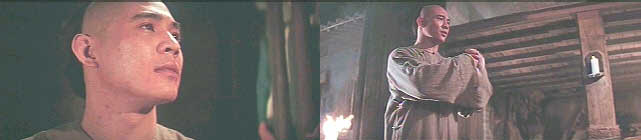
In 1990 Tsui Hark and Jet Li collaborated on a film that told of a martial
artist who finds himself in a situation where he has to defend the honor
of Po Chi Lam and his students in a world that had become very foreign to
him. The film was a disaster. It was considered to be so hopelessly bad that
it was not even deemed releasable. Who would have thought that within a year
this duo would move on from the debris of The Master to creating one of the
greatest martial arts films of all time.
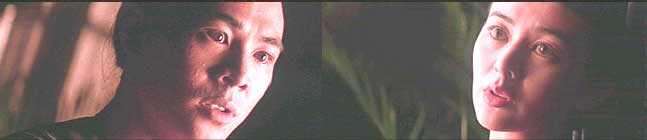
Both men were at a point in their careers where one had to question whether
the magic of their earlier films was gone. Jet Li began in the early 80’s
with the very impressive Shaolin Trilogy that highlighted what an astonishing
martial artist he was and also allowed him to display his boyish charm, but
since then little had gone right. The last of the trilogy was finished in
1986 and then Jet lumbered through his directorial attempt, Born to Defense,
that was such a critical mess that he moved to the United States for a while
to make the two low budget films, Dragon Fight and The Master. Even with
his immense skills, Jet must have fallen off the radar of most filmmakers
by 1991.
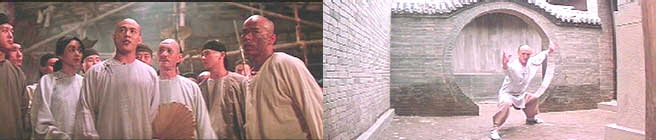
Tsui Hark of course began as the enfant terrible of Hong Kong film with his
first three experimental and distinctly edgy films – Butterfly Murders, We
are Going to Eat You and Dangerous Encounters that all showed little box
office appeal. Afterwards, Tsui joined up with Cinema City and embarked on
a glorious run of more commercial films (as either director or producer)
that helped change the face of Hong Kong film – Zu Warriors, Shanghai Blues,
Peking Opera Blues, Chinese Ghost Story and A Better Tomorrow. After 1986
though Tsui seemed to lower his aspirations and the successes were fewer
in the next four years. These films were solid but rarely inspired – I Love
Maria, The Big Heat, Gunmen, Web of Deception, A Better Tomorrow III and
The Master. ABT III actually did quite well at the box office but is still
considered a lesser Tsui Hark film. During this time he also produced The
Killer but that is perhaps rightfully primarily associated with John Woo.
In 1990 though Tsui again begin showing some of his earlier inspiration and
ambition with the first film in The Swordsman Trilogy and the sequel to A
Chinese Ghost Story, but it was to be another martial arts film about one
of China’s most legendary heroes that would bring both Tsui Hark and Jet
Li back into prominence.
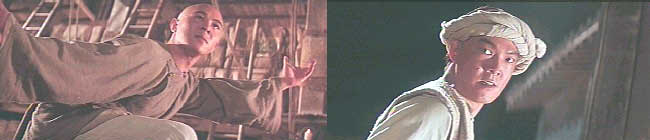
Traditional martial arts period films had been a major part of the Hong Kong
film market from the beginning of the industry and then totally dominated
the cinematic landscape from the late 60’s to the late 70’s when they began
to lose some of their steam and they almost dwindled out completely by the
mid-80s. Martial arts films were still being made but artists such as Jackie
Chan and Sammo Hung had brought them into contemporary settings and really
transformed them from the martial arts genre to a broader action genre. After
literally thousands of films exploring what seemed every possible facet of
the genre martial art films simply felt stale and exhausted. Beginning in
1990 though Tsui embarked on an incredibly ambitious series of films that
reinvigorated the martial arts, the wushu and the supernatural fantasy genres.
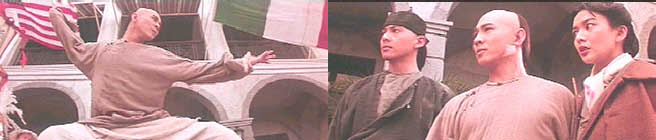
Not only did Tsui Hark decide to attempt to bring back the traditional martial
arts film but he chose to do it with as old and revered a chestnut as one
could find by re-telling the story of Wong Fei Hung. Wong Fei Hung was of
course a real person and a real martial artist who lived from 1847 to1924
and many films had been produced over time that detailed and embellished
his life story, but the man most identified with him was actor Kwan Tak-hing.
Kwan Tak-hing had portrayed Wong Fei Hung in over seventy films from The
Story of Wong Fei Hung in1949 to Dreadnaught in 1981. He brought a dignified,
disciplined and yet kindly air to the character that was very welcomed by
the Hong Kong audience. Tsui Hark decided not only to re-invent the martial
art film, but also to some degree to bring a fresh perspective to this legendary
character. Everything was to be bigger, faster, grander and more epic in
scale than what had come before and Tsui would also weave in the political
themes of nationalism, religion, fanaticism, westernization and imperialism
in a quickly changing world that occasionally feels out of control - themes
that are as relevant today as they were in the world of Wong Fei Hung.
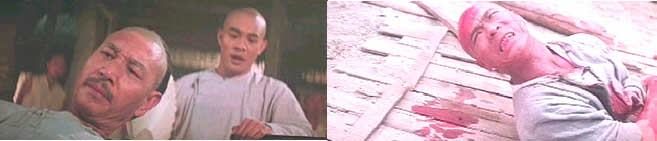
The period of time that Tsui chooses to pick for his martial arts epic is
one of the most fascinating in Chinese history and he exploits all the elements
of it to the fullest. At the end of the 19th century China was entering into
a period of history that would result in over fifty years of warfare, revolution
and political and economic upheaval that would change China in nearly every
way. The Manchu dynasty was crumbling after decades of mismanagement and
corruption, the military and economic rise of the West was allowing them
to act on their desires for imperialistic expansion, fanatical religious
movements were growing, Christianity was continuing its efforts to get a
toehold in China, small groups of revolutionaries were pushing for reform
and democracy, the triads were transforming from a patriotic group that was
initially formed to resist the Manchus to a criminal enterprise and technology
from the west was making its appearance in China and forcing China to examine
it’s long term policy of isolation that was now showing them what a weakened
position they were in. In the first three films of this series Tsui Hark
interweaves all these political and social threads into an amazing tapestry
that paints a nation in the throes of change, but it still remains a very
personable and intimate story of one man and the world he has suddenly found
himself in. These are also, lest I forget to mention, astonishing action
films filled with wondrous set pieces and breathtaking individual exhibitions
of physical skills.
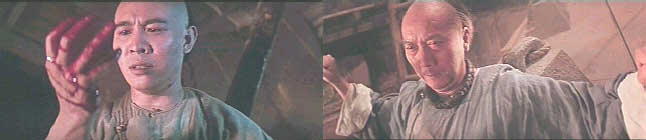
Within a few minutes of the first film, Tsui introduces many of these issues
and puts Wong Fei Hung squarely in the middle of it all. Jet Li in his portrayal
of Wong Fei Hung is a very different one than from his earlier roles – much
of the boyish charm is shed for a sterner and more dignified demeanor (almost
as if he senses Kwan Tak-hing’s shadow over his shoulder) that is loaded
with charisma. This role was to make Jet Li a huge star. Though the film
has many wonderful supporting characters – Yuen Biao as Foon in particular
is a standout – the real heart and symbolism of the film revolves around
three characters that all represent China to some extent.
Wong Fei Hung is the traditional China – set in his ways to a large degree
– but honorable, loyal, devoted to his family, his friends, his students
and the ways and customs of China. Rosamund Kwan as Aunt Yee represents the
need for China to modernize, to take the good things from the West but still
retain the Chinese identity. The romance that blooms between Wong and Aunt
Yee over the first three films are generally the sweetest and most touching
scenes of the films - tender moments left unspoken, near shadow plays of
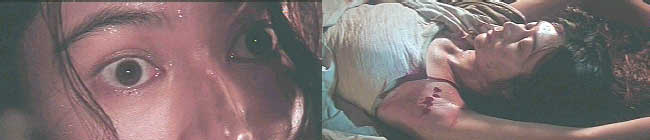
longing and innocence. The third character in the drama is Master Yim (Yam
Sai-kwoon) a magnificent martial artist fallen on hard times with no place
for him and his skills in the modern world - and so he sells out his
soul and joins the triads in order to make money. The anguishing scene of
him bending to collect coins in the pouring rain as Foon bears witness to
the death of the old world is a powerful bit of filmmaking.
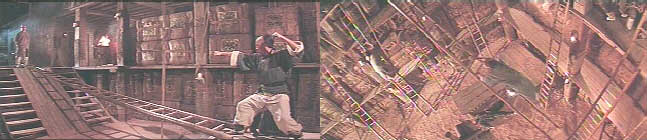
The film is a constant melee of action, but in particular the final thirty
minutes is absolutely emotionally riveting and action packed – from the moment
that Yuen sees a tied up Rosamund about to be raped to the final satisfying
flick of a bullet by Wong. Within this is also the legendary ladder duel
between Wong and Yim that encapsulates the frantic, inventive and quick editing
style of Tsui. The film has its share of weaknesses – it could have been
tighter, some of the comic bits feel out of place and the broad evil characterization
of the foreigners just looks like it belongs in another film.
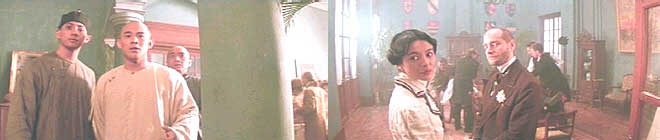
In the sequel (1992), Tsui again explores the clash of cultures and beliefs
and the turmoil that was overtaking a changing China. The time period for
this film can be set as angry crowds are protesting the Treaty of Shimonoseki
that was signed in 1895. This was the result of China’s defeat in the First
Sino-Japanese war and China was forced to cede the sovereignty of Korea and
Taiwan to Japan. Tsui of course can’t resist the political dig at the Mainland
by having a spectator ask, “Where is Taiwan” and having his friend respond,
“We have other things to worry about in Canton”.
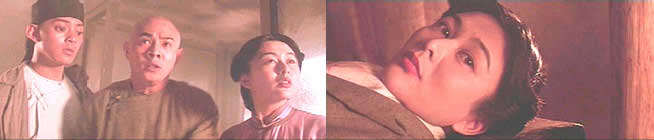
Wong Fei Hung has arrived in Canton with Aunt Yee and Foon (now played by
Max Mok) to attend a medical conference only to find the city in near anarchy.
The White Lotus Cult headed by the mystical Kung (Xiong Xin Xin) is fanatically
xenophobic and is attempting to destroy all the Westerners and rid China
of its influence. The shaky imperial government has sent Commander Lan (Donnie
Yen) to the city to restore control, but even more so to root out a band
of rebels headed by Sun Yat Sen (Cheung Tit-lam) and his second in command
(David Chiang). Lan is only too happy to use the cult in order to seek out
the rebels, but he finds Wong Fei Hung in his way. The politics of Wong are
difficult to distinguish – his stance is more one of siding with fairness
and justice rather than siding with a cause.
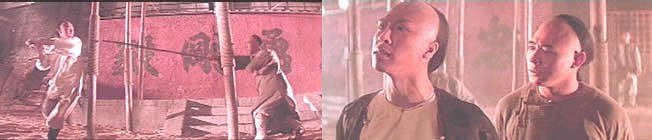
Much of the first hour of the film is taken up with setting up the characters
and the situation and there isn’t really much action until the second half.
From the point of the White Lotus Cult invading the British consulate though
the film becomes nearly a non-stop series of action set pieces. Two of them
are very good – Jet challenging Kung in a fairly wire enhanced duel and then
against Donnie in a more down to earth kung fu battle of poles and quick
reflexes.
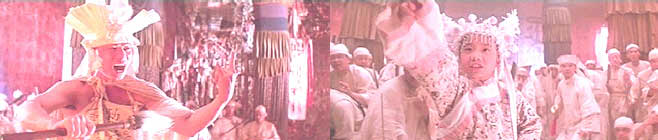
This film is more focused than the first and the narrative is stronger, but
it misses the interesting personalities of Yuen Biao, Kent Cheng, Jacky Cheung
and Yam Sai-kwoon. What is somewhat fascinating about this film is the shading
of gray of the supposed villains. Donnie is only following orders to find
the rebels and destroy them – some might consider him a patriot – as is true
for the character played by Xiong. He may have been fanatical in his beliefs,
but certainly reducing the influence of the foreigners was not an evil goal.
Though they are definitely the villains of the piece, Tsui allows the viewer
to understand where their actions are stemming from.
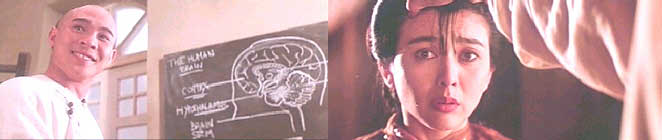
The box office success of the first two films led to yet another installment
in 1993 that is again directed by Tsui Hark. Though this film has some terrific
scenes, it lacks the energy and drive of the first two films and bogs down
at times in the interplay between Jet, Rosamund, the father and the romantic
rival. Tsui also seems to be making an attempt to lighten the Wong Fei Hung
character by allowing Jet to play him slightly goofy at times, act love struck
and display a ridiculous streak of jealously. The action scenes also fall
short of the previous films – they feel too chaotic, are sped up way too
much and make the characters take on almost superhuman abilities at times.
For me the film just didn’t click on an emotional basis – and I have to admit
to being one of those people who can only take a few minutes of Lion Dancing
before I am ready to nod out – and a story of rival Lion Dance clubs just
felt very small after the political intrigue of I and II.
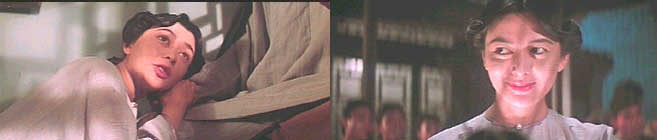
The film also does not have the requisite charismatic bad guy that is needed
in a film like this. The most interesting new character is of course Clubfoot
played by Xiong with a manic animal ferocity that eats up the screen, but
he ends up siding with Wong Fei Hung. From an emotional standpoint, it is
the humanity that Wong and Rosamund show a crippled Clubfoot and his switching
allegiance that is the most poignant part of the film. Everything else by
comparison feels routine. The best action set piece has Jet fighting on oil
slicked floors against a mass of men, but again the absence of a powerful
villain hurts the scene and the final lion dance/fight free for all seems
to go on for ever.
After this film there was a temporary rift
between star and director and Tsui brought in Chiu Man Cheuk (aka Zhao Wen-Zhou)
for numbers IV and V before bringing back Jet Li for Once Upon a Time in
America.
My rating for Once Upon a Time in China I: 9.0
My rating for Once Upon a Time in China II: 8.5
My rating for Once Upon a Time in China III: 6.0