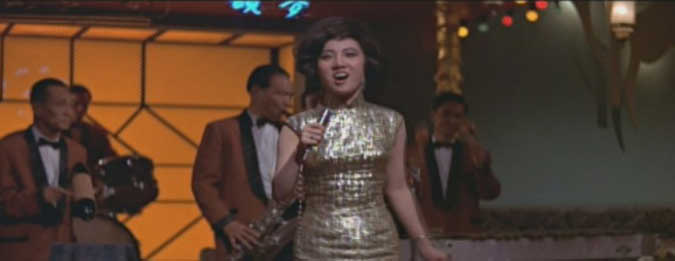
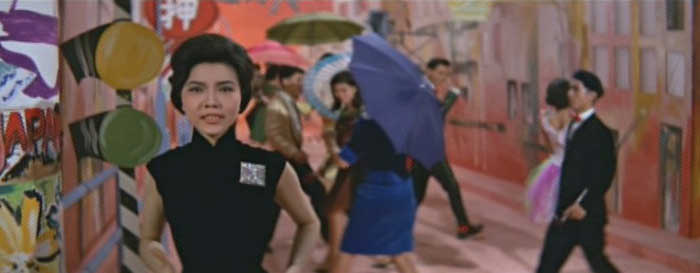
The Lark
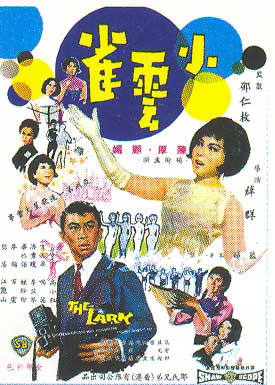
Director: Sit Kwan
Year: 1965
Rating: 6.0
This 1964 musical
from the Shaw’s has a somewhat labored plot that can be tiresome at times,
but in truth it is no more than an excuse to showcase some of the top female
Mandarin pop singers at the time. The film contains around fifteen musical
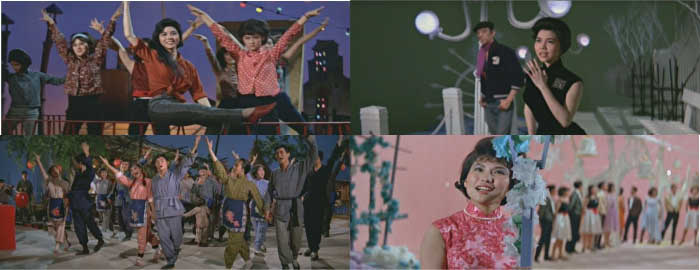
interludes of popular songs and it ends with a whiz-bang series of five big
production numbers. The songs are terrific; the story something of an effort
to pay much attention to. From a musical perspective it certainly feels like
a step forward from earlier Shaw musicals such as “Les Belles” and “Love
Parade” that were rather stiff and plodding in their execution of the musical
numbers. “The Lark” has a nice light mix of different scenarios in which
the musical pieces are spun out from your typical nightclub chanteuse number
to singing in a recording studio or around a piano to the big stage numbers
in the finale.
In particular, the film is a showcase for singer Carrie Ku-mei who had previously
been the singing voice for a number of stars in other films. One of her biggest
successes was doing this for Linda Lin Dai in the classic melodrama “Love
without End” and here again she gets the chance to sing the killer song “The
Love I Cannot Forget”, but with her own face on the screen this time. A number
of other singers make guest appearances such as Poon Sow Keng (Pan Xiuqiong)
who breaks hearts with her rendition of “Lover’s Tears” and the later to
be very famous Mona Fong who sings “Ava Maria” in both English and Chinese.
She is quite the dish and it is no wonder that Run Run went ga-ga over her
not long after this. Some other singers who appear are Mai Yin, Hua Yibao
and Lan Di.. Carrie was a very popular singer at the time, but had a rather
odd career background in that in the 1950’s she had been invited to Thailand
and had made some films there – I wonder what the chances of ever seeing
those are. She never had a lot of success though in her Hong Kong film career.
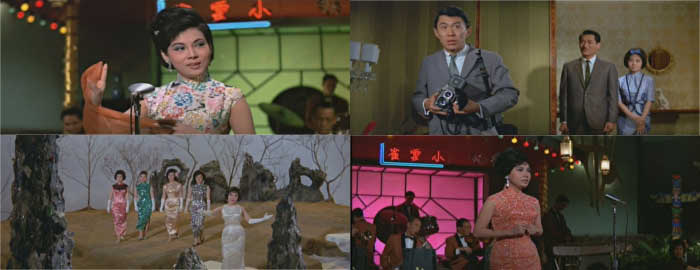
This film seems to have an echo of Carrie’s real life about it. Her character
Xiaoyun (also known as “The Little Lark”) has become famous throughout Southeast
Asia for her singing and is coming to Hong Kong to try her luck. She has
a love scandal that took place in Thailand lingering about her and the Hong
Kong press is hungrily looking for details to print. I guess some things
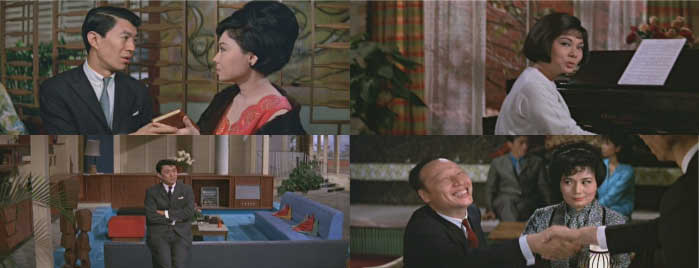
never change. One such rag sends reporter Shitai (Peter Chen) to get the
story, but he arrives late and mistakenly photographs Lydia Shum’s large
posterior and has that printed in the paper. His boss (Tien Feng) explodes
“how could that be the Little Lark” and tells Shitai that he better get the
story or he will be fired.
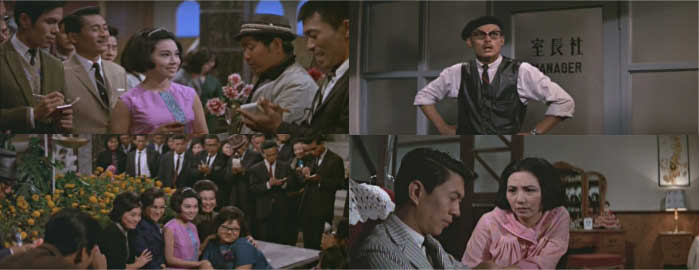
The opportunity to do so soon falls into his lap when Xiaoyun and her sleazy
agent mistake Chen for a wealthy music entrepreneur that they want to finance
a tour. He thinks about the ethics of this for a second and decides to play
along to get his story. This leads to frantic attempts by Shitai to continue
this charade and cover his tracks as he gets more and more over his head
with lies that lead to bigger lies. The film bogs down considerably with
the side characters of Shitai’s sister and her henpecked husband (played
by Kao Pao-shu and Chiang Kwong-chao) who quarrel constantly. There is a
small bonus of seeing Peter Chen in an action scene – a first for me – when
he takes on three creeps who try and rape the Little Lark.
The film never quite works on either a humorous or a romantic level – the
attempts at screwball comedy feel forced and there is little chemistry between
the two characters who seem to have little in common besides wanting to use
one another. In the end, the film seems to advocate the idea that deception
and deviousness is o.k. as long as you get the girl and a dream job in the
end. If you are a fan of early 60’s Mandopop watching the film is still a
pleasure. The composer of the songs was Gu Jiahua and Lin Qin and Lan Shi
wrote the lyrics. The film has many familiar Shaw faces in early bit parts
such as Ku Feng, Li Kun, Chiao Chuang, Chen Hung-lieh, Lee Wan Chung and
one of my favorite character faces of both Shaw and Cathay films, Tsang Choh
Lam, who usually plays waiters and other small walk on bits but actually
gets to do a small dance here in one of the big numbers.
My rating for this film: 6.0 (4.0 for the story;
8.0 for the music)
Below are the guest singers - a few I can identify
- a few I guessed at - but if you know who the others are please let me know.
Thanks.
Mona Fong
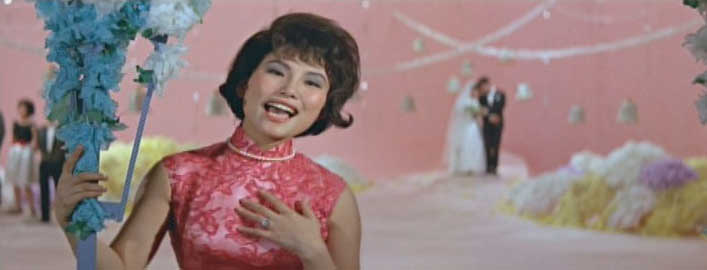
Pan Xiuqiong
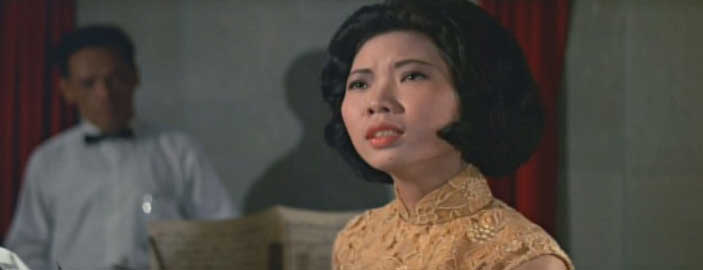
Lan Di
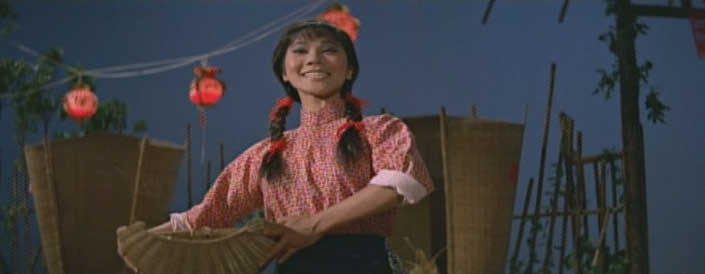
Hua Yibao
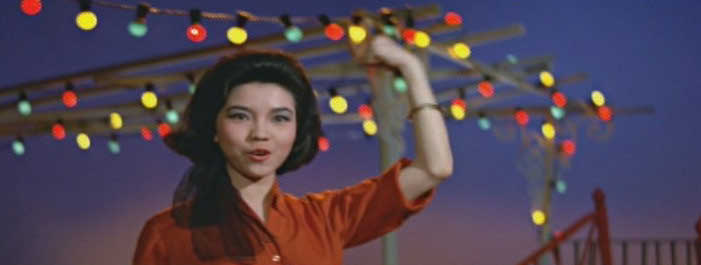
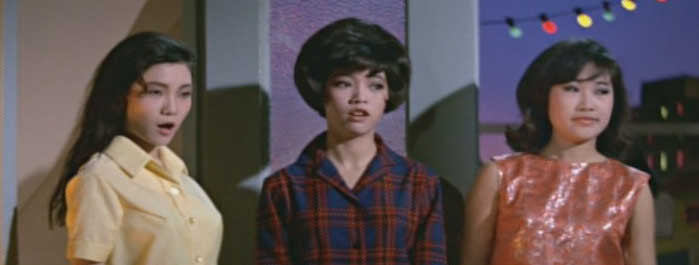
Mai Yin